


I. Blood-Bought Ballots
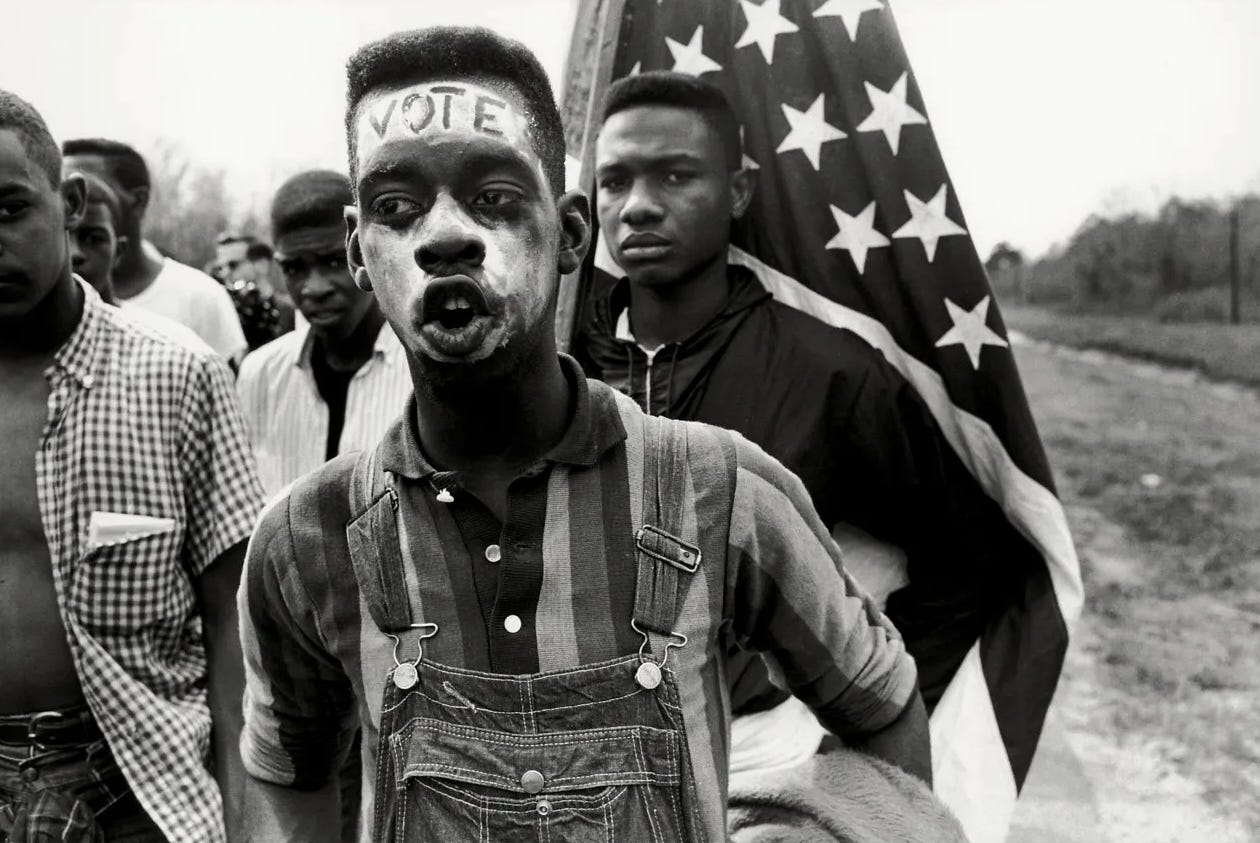
In spring 1965, photographer Bruce Davidson1 was in Alabama—somewhere between Selma and Montgomery—when he made this portrait of a young Black marcher with the word “Vote” painted on his forehead. The young man was one of approximately 600 marchers, led by activists including John Lewis and Hosea Williams, who were marching from Selma to Montgomery to demand voting rights. On that first day, as protestors crossed the Edmund Pettus Bridge in Selma, state troopers and a deputized posse of local citizens (all of whom were white) charged the peaceful protestors, violently beating them with batons and firing teargas at the crowd. Bloody Sunday, as it became known, was a tipping point for the civil rights movement. Disturbed by the violent news imagery coming out of Selma, President Lyndon B. Johnson delivered a special message to a Joint Session of Congress urging the passage of the Voting Rights Act.2 It’s the speech where the refrain “We shall overcome” originated. The Voting Rights Act (VRA) of 1965 was signed into law less than six months later.
For sixty years, this landmark ruling stood as the civil rights movement’s crowning achievement. Not only was it a testament to the movement, but also to the many people who bled and died to make it a reality. As Kareem Crayton writes in an essay for the Brennan Center for Justice, the Voting Rights Act triggered a seismic shift in the nation’s political landscape:
[The VRA] was enacted as a comprehensive tool meant to undo the political hold of Jim Crow policies in the South and related discriminatory structures nationwide. Congress adopted the law to ensure that states followed the 15th Amendment’s guarantee that the right to vote not be denied because of race. The law fundamentally opened political opportunities for Black and brown communities to participate in all aspects of the political system on an equal basis.
Section 5 of the law requires jurisdictions with a history of discrimination to obtain approval from the Department of Justice or a court before changing voting rules, a process known as “preclearance.” Section 2 of the law allows people to sue — either on their own behalf or with the assistance of the Justice Department — to undo existing laws and procedures that would deny equal political opportunity to voters to elect their candidates of choice.
Over the last two decades, however, a series of landmark decisions by the Supreme Court under Chief Justice Roberts have eroded the VRA. Most notably, Shelby County v. Holder (2013) and Brnovich v. Democratic National Committee (2021).
In Shelby County v. Holder (2013), the Supreme Court struck down a key formula in the Voting Rights Act that determined which states had to get federal approval before changing their voting laws. This decision effectively removed the “preclearance” requirement, freeing previously monitored states (i.e., jurisdictions with a documented history of racial discrimination) to change voting procedures without prior federal review. As you might imagine, the removal of these protections paved the way for the return of Jim Crow–era tactics. For example, after the ruling, numerous states—particularly in the South—enacted strict voter identification requirements, sweeping purges of voter rolls, and closures of polling places.
In Brnovich v. Democratic National Committee (2021), the Supreme Court ruled 6-3 that two Arizona voting laws did not violate the Voting Rights Act. By doing so, the Court made it significantly harder for civil rights groups to challenge future voting regulations in court. For context, here are the two Arizona laws that were upheld:
Out-of-Precinct Voting: A policy requiring that ballots cast in the wrong precinct be entirely discarded.
Ballot Collection Ban: A statute (often referred to as “ballot harvesting”) that made it a crime for anyone other than a postal worker, election official, caregiver, or family member to collect and return another person’s early mail-in ballot.
Critics of the Supreme Court’s decision argued that these rules disproportionately affected minority voters—particularly Native Americans in rural areas. Not surprisingly, the Supreme Court majority justices disagreed, saying that these inconveniences did not equal illegal discrimination.
Most recently (i.e., last month), Louisiana v. Callais (2026) dealt a potentially fatal blow to the Voting Rights Act by ruling that Louisiana’s voting map was an unconstitutional racial gerrymander. To understand why, some context is required. In 2024, a second majority-Black district was added to Louisiana’s voting map to better represent the state’s population. Since Black residents make up roughly a third of Louisiana’s population, federal courts determined that a previous single-district map unlawfully diluted minority voting power and required the state to draw a second district to ensure fair representation. Louisiana v. Callais eliminates fair representation, which is critical in a state like Louisiana. By striking down efforts to remedy racial vote dilution, this ruling makes it nearly impossible to stop states from drawing voting maps that entrench partisan power.
II. Beware the One-Party State
With the Voting Rights Act of 1965 defanged by the Supreme Court, Snyder’s third lesson is more timely than ever: Beware the one-party state. This lesson is framed as follows:
The parties that remade states and suppressed rivals were not omnipotent from the start. They exploited a historic moment to make political life impossible for their opponents. So support the multi-party system and defend the rules of democratic elections.
Defending the rules of democratic elections has become increasingly difficult amid the political instability of the last decade. Trump 1.0 not only shocked and repulsed us, it beat us down. Living under the thumb of a power-hungry narcissist devoid of empathy diminished us all more than we understand. Mix in a worldwide pandemic marked by loss of family and friends and we are even less whole. That collective trauma is still revealing itself. Biden did not provide the deliverance we so desperately needed. In fact, the Democratic party’s inability to take a beat after his victory and commit itself to a practical and productive agenda only further disadvantaged us while increasing our disillusion. And Trump 2.0 has been horror from the start.
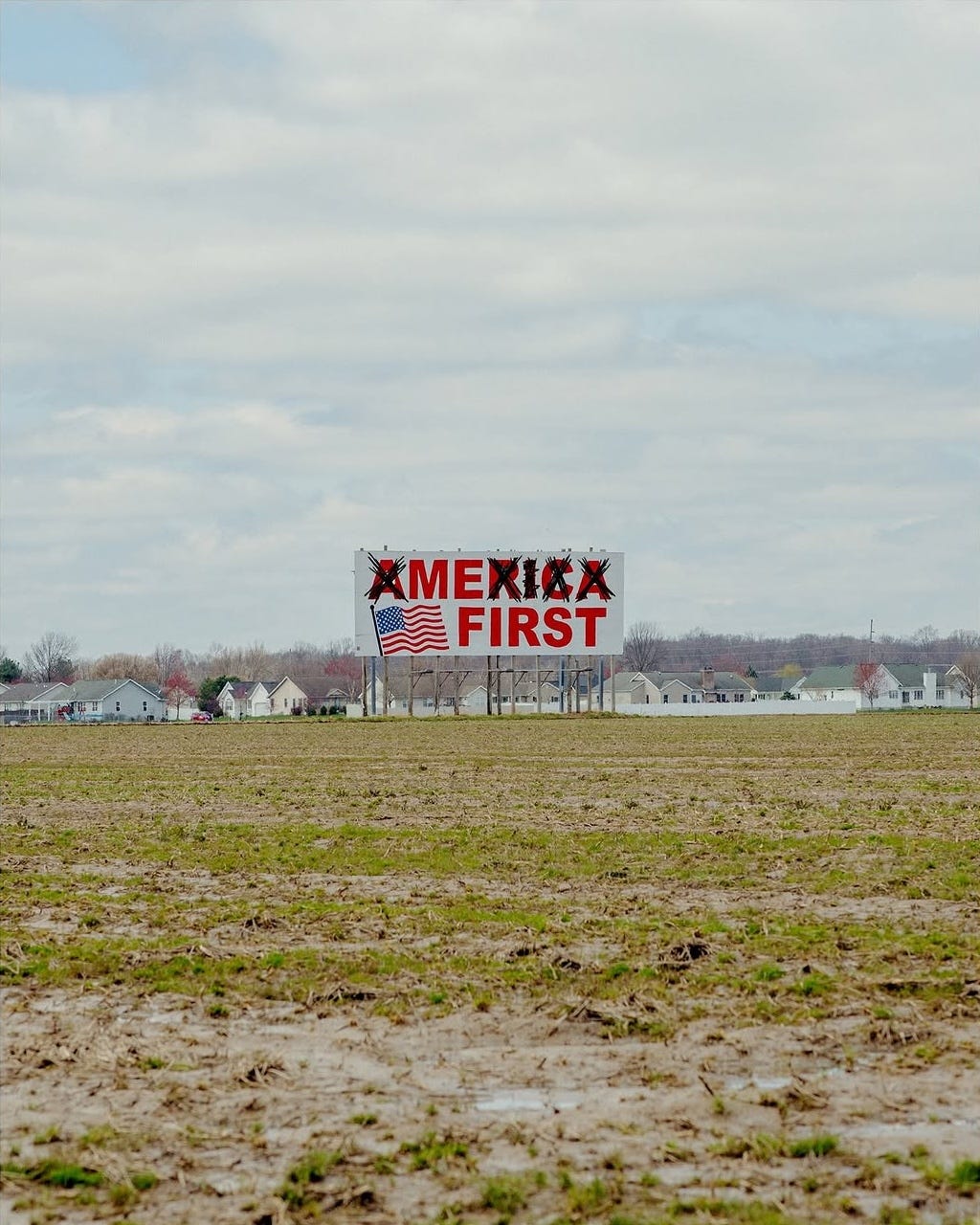
Much like the core tenets of the Voting Rights Act have eroded over time, so too has our ability to operate, maintain, or even pretend to have a democracy that aspires to be a force for good in the world. We are dangerously close to the one-nation party Snyder warns us about in lesson three from On Tyranny. We are living in and through the type of “historic moment” Snyder references. We are living in a new type of nadir, where ethics and morals are not even part of a national discussion, and me-first nationalism is interpreted in the most selfish terms possible by politicians and billionaires alike. It is far more insidious, and also proof that Republicans are masters of the long game, where Democrats are decidedly not. The Court’s 6–3 conservative super majority has remade our sociopolitical landscape in its own image—rolling back critical legal protections that have made life less safe for us all, but more so for women and people of color.
III. The Election Underminers
This past February, the Brennan Center for Justice, a nonpartisan law and policy institute, published a timeline of the Trump administration’s efforts to undermine elections. As you might have guessed, the timeline—which tracks a single year, February 2025 to February 2026—reveals a string of actions, incidents, and decisions that have weakened election integrity. I recommend looking through the timeline yourself, but I've highlighted some key points.
February 14, 2025—Cybersecurity and Infrastructure Security Agency (CISA) freezes all election security activities; DHS cuts funding for EI-ISAC.
March 3, 2025—The federal government supports election official convicted of election interference.
March 6, 2025—The DOJ dismisses its redistricting case in Texas.
March 25, 2025—The president issues an executive order on elections.
April 7, 2025—An election denier is sworn in as head of civil rights at the DOJ.
April 8, 2025—The DOJ dismisses its pro-voter case against Arizona.
May 12, 2025—The DOJ begins requesting states’ election-related records and voter list records
August 18, 2025—The president threatens to unlawfully end mail voting.
September 2, 2025—The DOJ reportedly requests access to Missouri’s voting equipment
November 7, 2025—The president pardons 77 allies who supported plans to subvert the 2020 election.
December 15, 2025—DOJ files suit in Fulton County, Georgia, for 2020 election records.
IV. The Future Lies in Uncertainty
I have to believe that recovery from all of this social, cultural, and political upheaval is still possible. But on good days it feels overwhelming, and on worse days it borders on hopeless. In recent months, however, as Instagram has been serving me a fairly steady diet of Ryan Holiday videos, I’ve found some helpful nuggets of wisdom in his Daily Stoic project. Today’s nugget was a quote from Seneca, the Stoic philosopher, and it’s the type of reminder that’s probably best paired with a clock somewhere in your house: “The whole future lies in uncertainty; live immediately.”
KEEP READING
Do Not Obey in Advance
A close reading of Timothy Snyder’s ‘On Tyranny: Twenty Lessons from the Twentieth Century,’ and how it can act as a tool for democratic resistance in unprecedented times.
Defend Institutions
In the wake of the Trump Administration’s crushing blow to American museums and libraries, we take a closer look at the second lesson from Timothy Snyder’s ‘On Tyranny.’
V. Recommended Reading
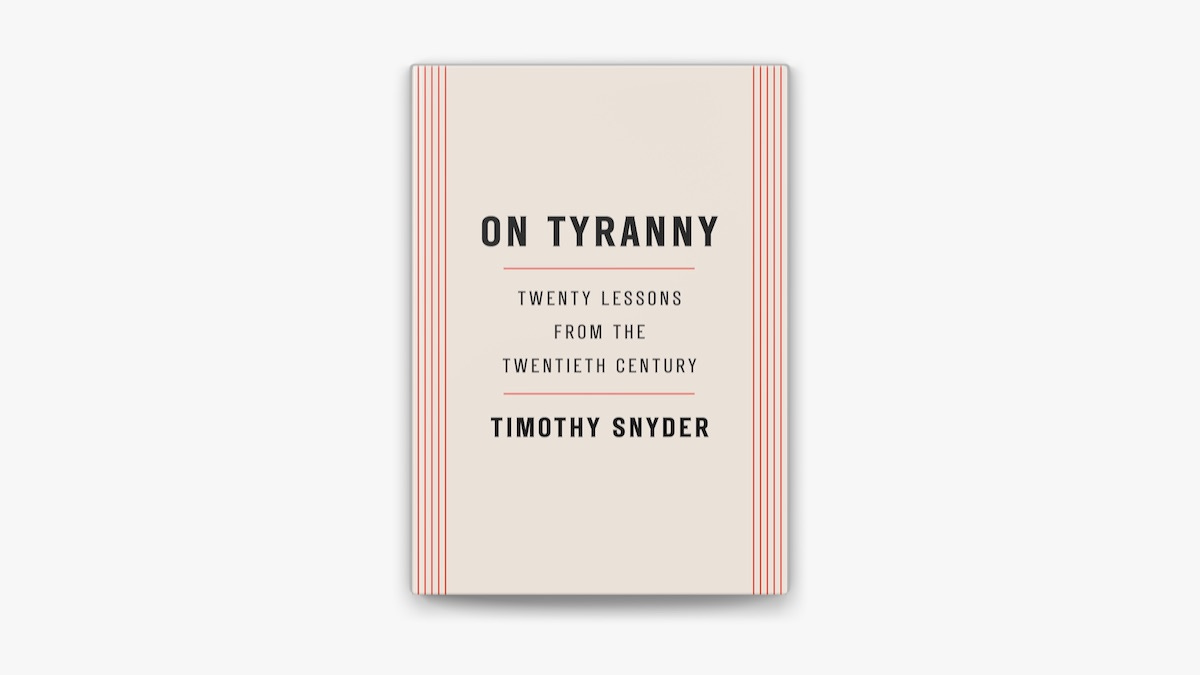
“Timothy Snyder reasons with unparalleled clarity, throwing the past and future into sharp relief. He has written the rare kind of book that can be read in one sitting but will keep you coming back to help regain your bearings.” —Masha Gessen
The Founding Fathers tried to protect us from the threat they knew, the tyranny that overcame ancient democracy. Today, our political order faces new threats, not unlike the totalitarianism of the twentieth century. We are no wiser than the Europeans who saw democracy yield to fascism, Nazism, or communism. Our one advantage is that we might learn from their experience.
On Tyranny is a call to arms and a guide to resistance, with invaluable ideas for how we can preserve our freedoms in the uncertain years to come.
KEEP READING
Do Not Obey in Advance
A close reading of Timothy Snyder’s ‘On Tyranny: Twenty Lessons from the Twentieth Century,’ and how it can act as a tool for democratic resistance in unprecedented times.
Defend Institutions
In the wake of the Trump Administration’s crushing blow to American museums and libraries, we take a closer look at the second lesson from Timothy Snyder’s ‘On Tyranny.’
📚 Independent, Reader-Supported Publishing 📚
Each issue of Homesick requires extensive time and resources before the writing ever begins. From research, interviews, transcription, and image sourcing to fact-checking, copyediting, proofreading, design, and marketing, the work that goes into each newsletter is substantial. If you enjoy the Dispatches, Essays, and Interviews that I publish each week, please consider supporting my work in one of the following ways:
SUBSCRIBE ➡️ Subscribe to Homesick, free or paid subscription.
RECOMMEND ➡️ Refer Homesick to a friend.
PURCHASE MY BOOK ➡️ Buy Shopping Mall, my book about the curiosity, ritual, and fantasy of the American mall.
TIP YOUR EDITOR ➡️ Not ready for a paid subscription? Tip your editor via PayPal.
This piece contains an affiliate link for Bookshop.org, a retailer that supports local bookstores. As an affiliate of Bookshop, Homesick earns a small commission when you click through and make a purchase there.
Davidson, who was not on assignment for a particular publication, had been independently documenting the civil rights movement since the early 1960s as a member of the Magnum Photos cooperative. He traveled with the Freedom Riders in 1961, and later documented various small demonstrations and arrests in the spring of 1963, before documenting the march from Selma to Montgomery.
Here is the full transcript of Johnson’s speech: https://www.pbs.org/wgbh/americanexperience/features/lbj-overcome/.
The Democratic Party establishment and its political leaders are not interested in Justice. They are interested in the judicial system agreeing with them, no matter what. https://torrancestephensphd.substack.com/p/fighting-and-dying-for-segregation