


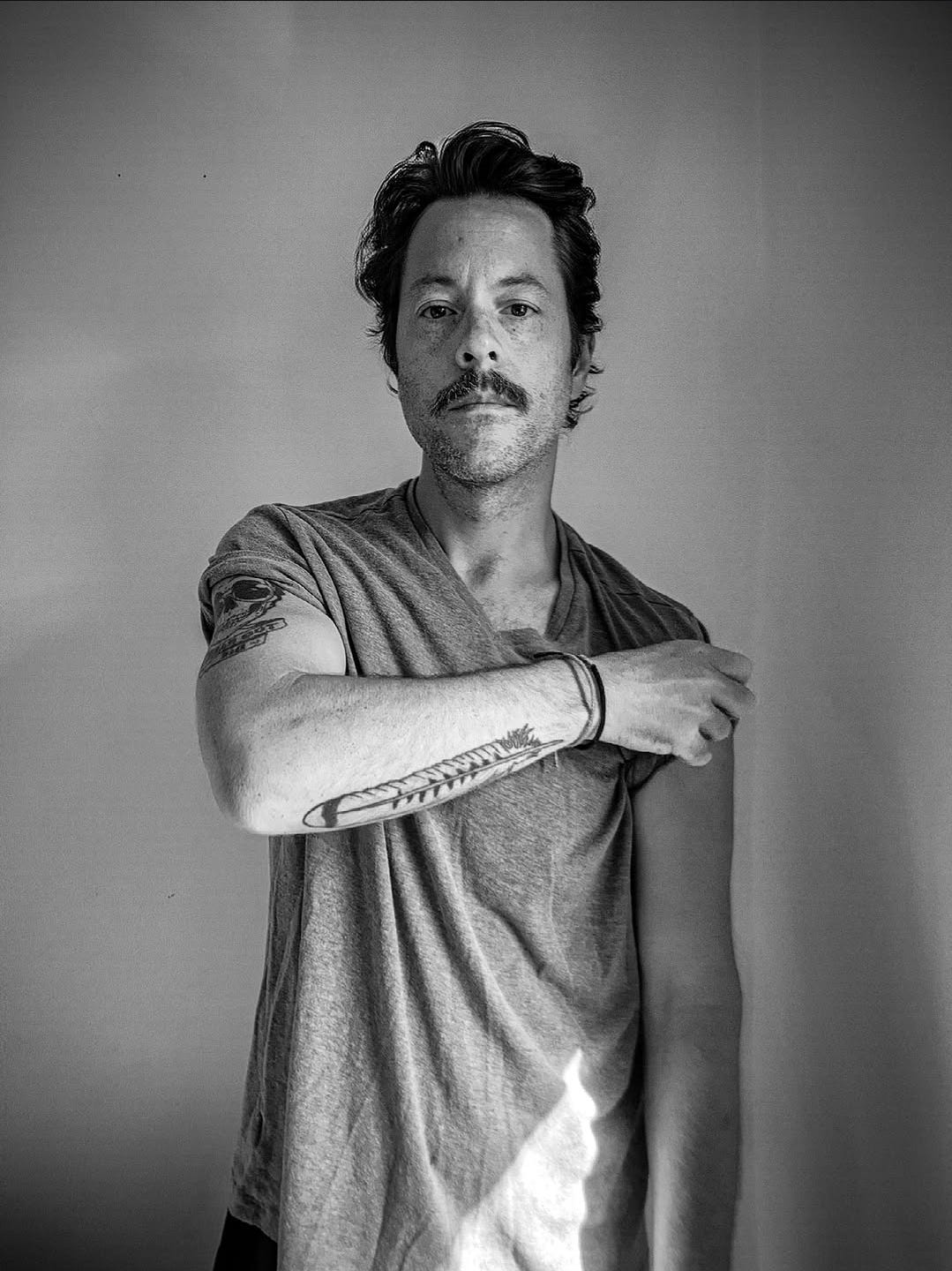
IN THE AGE OF INFINITE SCROLL, moments that give pause are rare. This is particularly true in the world of images, where AI fuckery is pervasive—dominating feeds, dredging IP from the internet like a fishing trawler. At the beginning of March, however, I came across an artwork that stopped me mid-scroll.
It was a striking illustration of an abandoned Philadelphia row house. Bricks painted electric blue are what caught my attention first. It reminded me of a mistint color you’d find on the clearance shelf at a hardware store. Atop the building, the weathered white trim sat like a tarnished crown. Beneath it, a pair of windows. One was like a black eye earned in a fight, the other cracked open enough to coax the weather inside. A piece of graffiti-covered plywood stood in place of a door. Crabgrass sprouted from the foundation, set behind a sidewalk washed in gray watercolors—all punctuated by a blood-red fire hydrant.
The drawing is the work of Phil Perry, a Philadelphia-based artist who, a couple of years back, began biking around the city to photograph old row houses. What struck me about this particular image—a crumbling house gone to ruin—was how much character it had, and how well Perry captured that character. It is an image of decay without the usual melancholy. In other words, this is not ruin porn. It’s quite the opposite. It’s a celebratory homage to a building on borrowed time. And Perry is very aware of each building’s numbered days.
“This is an almost wreckless blue and it seems like the bricks are holding on out of spite and about ten layers of paint,” Perry wrote in the image caption. “I like drawing these places because once they’re gone, they’re gone.”
What’s most interesting is that Perry, 42, is not a career artist. In 2024, as he faced growing health problems, he turned to drawing as a way to cope. I recently talked to Perry about his art, Philadelphia, and his health. Our conversation is included below.
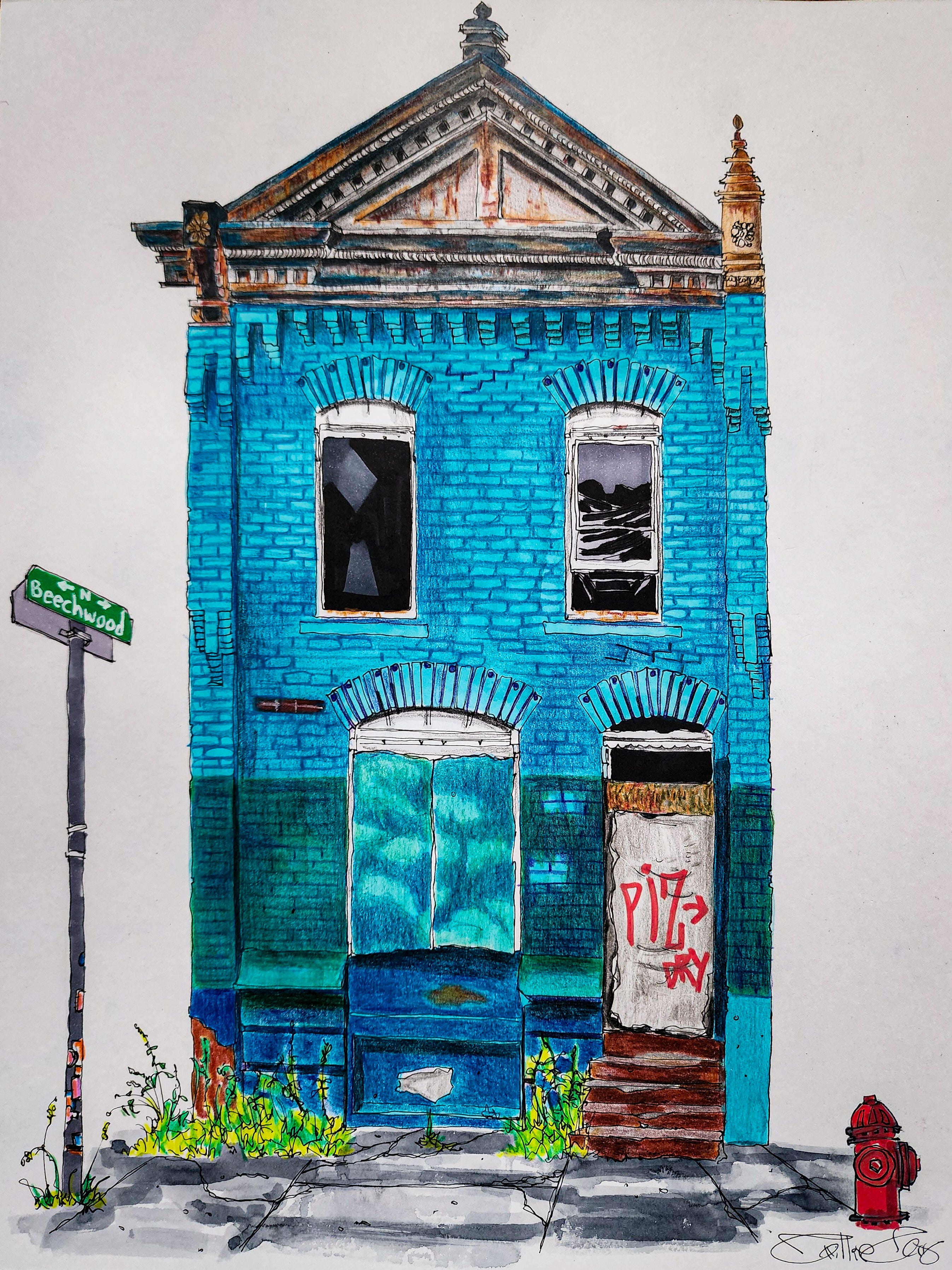
Can you tell me about your background and how you arrived at drawing?
I was diagnosed with Crohn’s disease two years ago and was stuck in my apartment for about a year. It takes them a while to puzzle it out, and then our health care system is prohibitive, so I had a lot of problems getting care until I could get insurance. I basically couldn’t leave my apartment, so I was in there drawing.
Had you drawn seriously before that?
I’ve always liked drawing and looking at things—architecture, that type of thing—but I never really went out and bought art supplies. It came out of nowhere.
How did you start getting your work out there?
After a while, I would take my artwork down to Rittenhouse, a park in Center City, basically trading it for Phillies tickets. But people started buying it, so I started posting it on social media. I actually have a little bit of a background there. I used to be a sponsored long-distance hiker and lived in New Hampshire for a while, where I built out a couple of accounts in the outdoor space. I had tens of thousands of followers and would get endorsements from REI, Eastern Mountain Sports, that kind of thing. I thought if I used some of the same consistent social media strategies, it could pay off with artwork—and it did. I took my followers down to about 500, started fresh, and it went viral pretty quickly.


What are “China stores,” and why did you start drawing them?
A China store is essentially what New Yorkers call a bodega—a corner store where you can get anything. Chinese food, American food, cigarettes, alcohol, chips, drinks, whatever you want. Every neighborhood has one regardless of income level. They kind of transcend everything about income, color, nationality. Everybody at least twice a week walks down to the corner and goes into their China store and buys something. Some of them are iconic, and even the ones that aren’t iconic are iconic to the people in those neighborhoods.
North Philly row homes are the primary focus of your illustrations. What is it about those buildings that appeals to you?
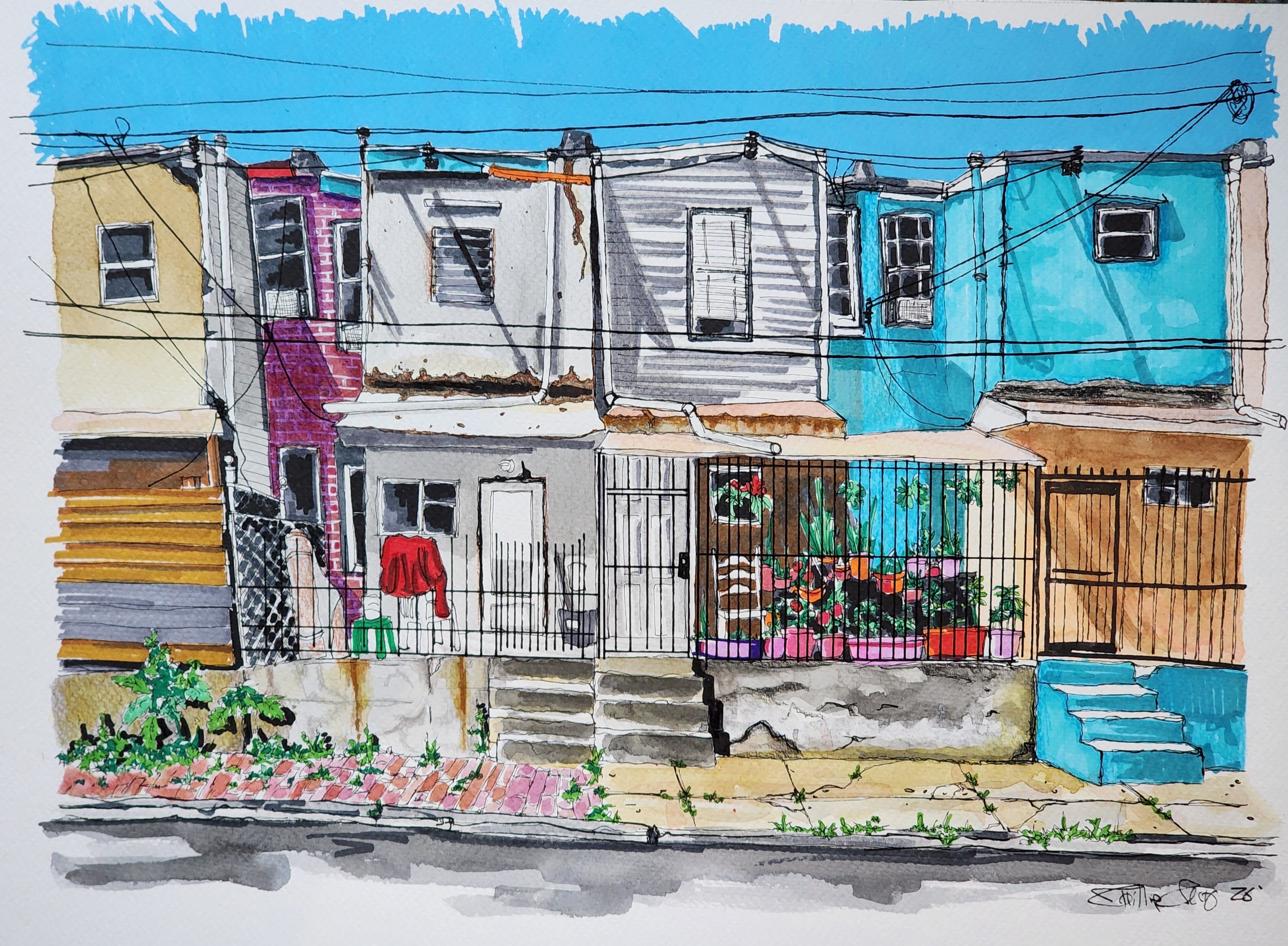
I find them really interesting because we just couldn’t build them like that anymore. Those were built in the early 1920s for factory workers—they’re brick, they have ornate wood crowns, and everything on top. There aren’t enough people with that skill set anymore. Those were first- and second-generation Americans who built that stuff. And when you see them getting renovated now, they don’t restore them—they take them down to a skeleton and put back aluminum siding. Once those buildings are gone, that’s it.
Your drawings seem to exist on two levels: aesthetics and documentation. The finished images are striking in their own right and capable of stopping someone mid-scroll, but they also serve as a beautiful record of neighborhood life.
Nobody gives a shit about those neighborhoods—they just don’t. No artist is going up to North Philly to draw these houses or care about the stories the people there have to offer. It is an underrepresented slice of society, really, when you think about it. And I think that’s partly why the drawings took off—those communities never see any representation of what’s going on in their neighborhoods. Go look at the Diamond Market post and read through the comments to see how many people recognized that place. That’s what I mean.
Are you working from your own photos or other people’s?
I ride my bike everywhere, so a lot of them are my own photos. There’s also a guy I know, David Krevolin who runs Rowhouse City, and we do a kind of collaboration that drives engagement a little more, so I use his photos a lot too.
What materials are you using in the work?
Everything—colored pencils, pen, ink, watercolors, and acrylic. You name it.
You’re pretty open about using social media strategically, even when a lot of artists resist it. Why do you think that is?
I think there are two spaces in the creative universe. One is inclusive—people making art to make art, which is most people. The money isn’t the important part, so there’s no marketing aspect, and there’s room for everybody. But the second space is: your artwork isn’t worth anything unless people can see it. You have to have something that stops people’s scrolling fingers. A lot of artists say they hate social media, but where else are you selling your artwork? Going to art fairs means competing directly against everyone who’s been doing it longer than you. You should be using every angle at your disposal. I sold 150 prints last week to people I didn’t know, without leaving my house.
What’s next for you?
T-shirts. I want to do designs on shirts, and I’m also trying to get something together around the Phillies before Opening Day.
📚 Independent, Reader-Supported Publishing 📚
Each issue of Homesick requires extensive time and resources before the writing ever begins. From research, interviews, transcription, and image sourcing to fact-checking, copyediting, proofreading, design, and marketing, the work that goes into each newsletter is substantial. If you enjoy the Dispatches, Essays, and Interviews that I publish each week, please consider supporting my work in one of the following ways:
SUBSCRIBE ➡️ Subscribe to Homesick, free or paid subscription.
RECOMMEND ➡️ Refer Homesick to a friend.
PURCHASE MY BOOK ➡️ Buy Shopping Mall, my book about the curiosity, ritual, and fantasy of the American mall.
TIP YOUR EDITOR ➡️ Not ready for a paid subscription? Tip your editor via PayPal.
🗄️ Visit the Archives 🗄️
If you enjoyed this interview, I recommend checking out one (or more) of the many stories we’ve published. To read more, visit the archives.

This article was fantastic. Bravo. And, thankyou for featuring me.