


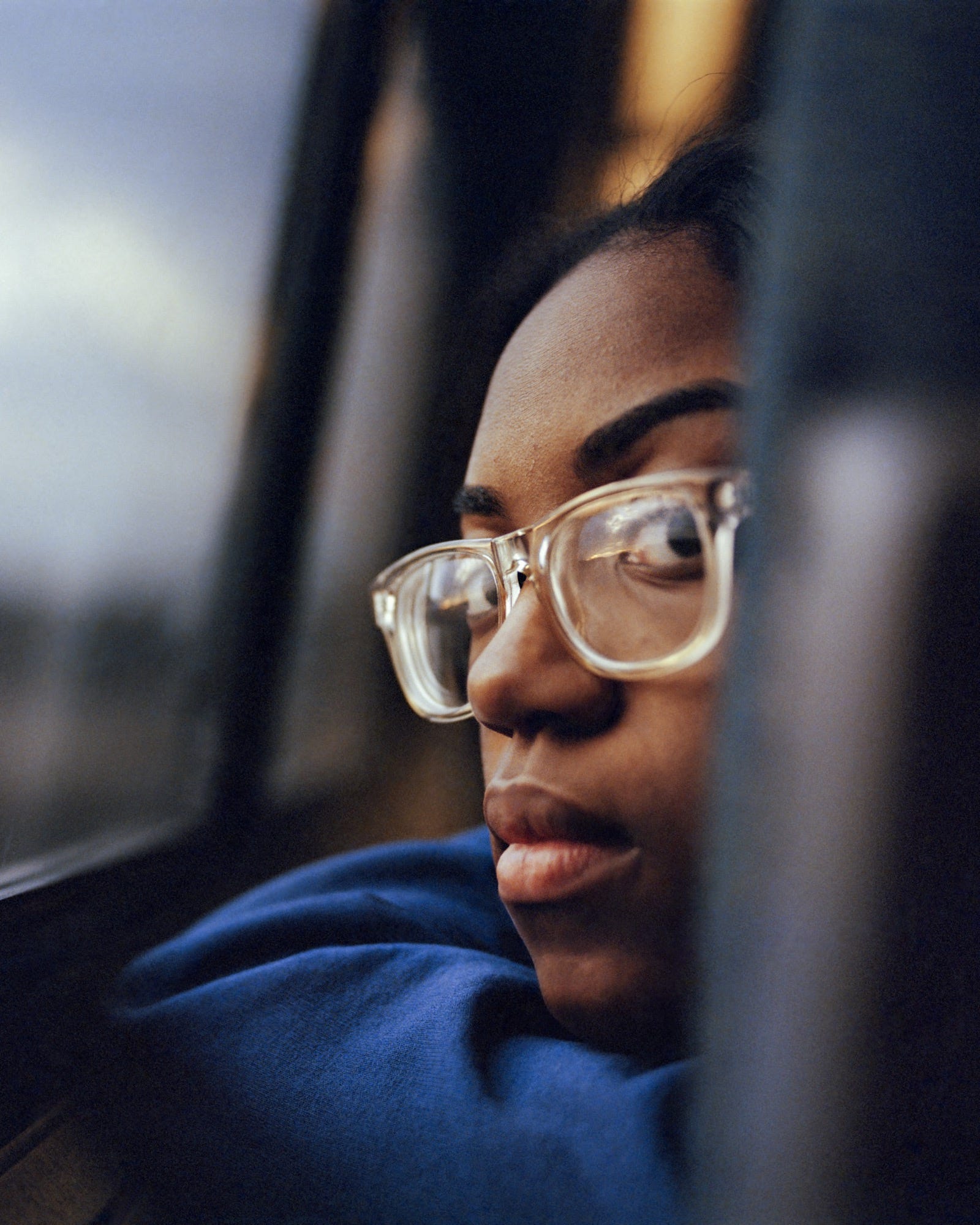
On a passenger train from New York to North Carolina, a young Black woman turns to look behind her, a movement that frames her face in the gap between her seat back and a window revealing a blue and white sky anchored by dark trees. The woman, whose name is Jada, is on her way to visit family near Charlotte.
“This is my first time ever on a train ride this long,” she writes in a journal entry. “I’m excited to get away from the city since the farthest I’ve ever traveled was to Maryland.”
This portrait, part of photographer McNair Evans’ drawn inward series—which invites train passengers to write why they are traveling, where they are coming from, and where they hope to go—was taken in December 2024, several days before Christmas. A few months earlier, Jada had reunited with family members and was invited to visit during the holidays. When Evans met her, the train was crossing the Virginia border into North Carolina, and he made two portraits. In the first, Jada cradles her chin in her left hand while her blue nail polish mirrors the color of her shirt, yet her face is out of view. It is an ambiguous image, malleable and untethered without its pair. The second is the portrait where Jada turns to look behind her, an honest intensity in her eyes. She wants to help people, she writes in the last sentence of her journal entry, by working as a therapist for children and adults. Apart, the pictures act like pregnant pauses, so much weight between them. Together they are a sequenced encounter, a closed loop.


Each portrait and first-person account from drawn inward are as much a meditation on the heartache, euphoria, and malaise of the present as they are an investigation of what it means to live in limbo. Evans understands that these passengers are more than avatars. They remind us of the many questions we ask ourselves when shuttling back and forth in our lives. Who are we when we are not at home? What does it mean to live between worlds? When does travel become another excuse to ignore reality? Where are we able to be our truest selves? Why is it so difficult to quiet our minds? How do we reconcile the people we are—and the people we become—between destinations?
“Train interiors are inherently liminal spaces,” Evans explains. “While the passengers change, the backdrop stays the same. The effect is democratizing. People shown in the same space—separated from their environments and possessions—hanging between departure and destination.”


In the pictures that Evans makes, the train car becomes an inflection point between the present and the future, or a physical or metaphorical interzone that evokes feelings of ambiguity or unease. These spaces, so familiar they border on forgettable, still evoke a sense of dread. For Evans, the train car is a blank slate to project the myriad visions he has composed. Empty seats bathed in golden sunlight. An older woman smiling as the baby she holds in her arms touches her face. A balding man in a three-stripe Polo shirt stares at nothing while getting lost in his thoughts. These projections extend beyond the train car too. A prismatic orb floating above iron rails and wooden crossties. Skeletal trees bent like spines along riverbanks. Monuments in mist seen at a distance.
In Evans’ drawn inward series, travel is as mutable as the space inside a train car or the emotions of passengers or the landscape outside their window. After all, no space is more transitory than an airplane between terminals or a car between stops or a train between stations. These spaces are some of the last where we remain suspended in time, closed off from the turmoil of the world.
This essay originally appeared in the catalog for the exhibition Radial Survey Vol. 4, on view November 6, 2025–February 7, 2026 at Silver Eye Center for Photography in Pittsburgh.
📚 Independent, Reader-Supported Publishing 📚
Each issue of Homesick requires extensive time and resources before the writing ever begins. From research, interviews, transcription, and image sourcing to fact-checking, copyediting, proofreading, design, and marketing, the work that goes into each newsletter is substantial. If you enjoy the Dispatches, Essays, and Interviews that I publish each week, please consider supporting my work in one of the following ways:
SUBSCRIBE ➡️ Subscribe to Homesick, free or paid subscription.
RECOMMEND ➡️ Refer Homesick to a friend.
PURCHASE MY BOOK ➡️ Buy Shopping Mall, my book about the curiosity, ritual, and fantasy of the American mall.
TIP YOUR EDITOR ➡️ Not ready for a paid subscription? Tip your editor via PayPal.
📖 Read More Essays 📖
Did you enjoy this essay? If so, you might be interested in reading some of the other writing on topics personal, political, and provocative in the Homesick archives. Sometimes a long read. Other times short. To read more essays, visit the archives.
