


I.
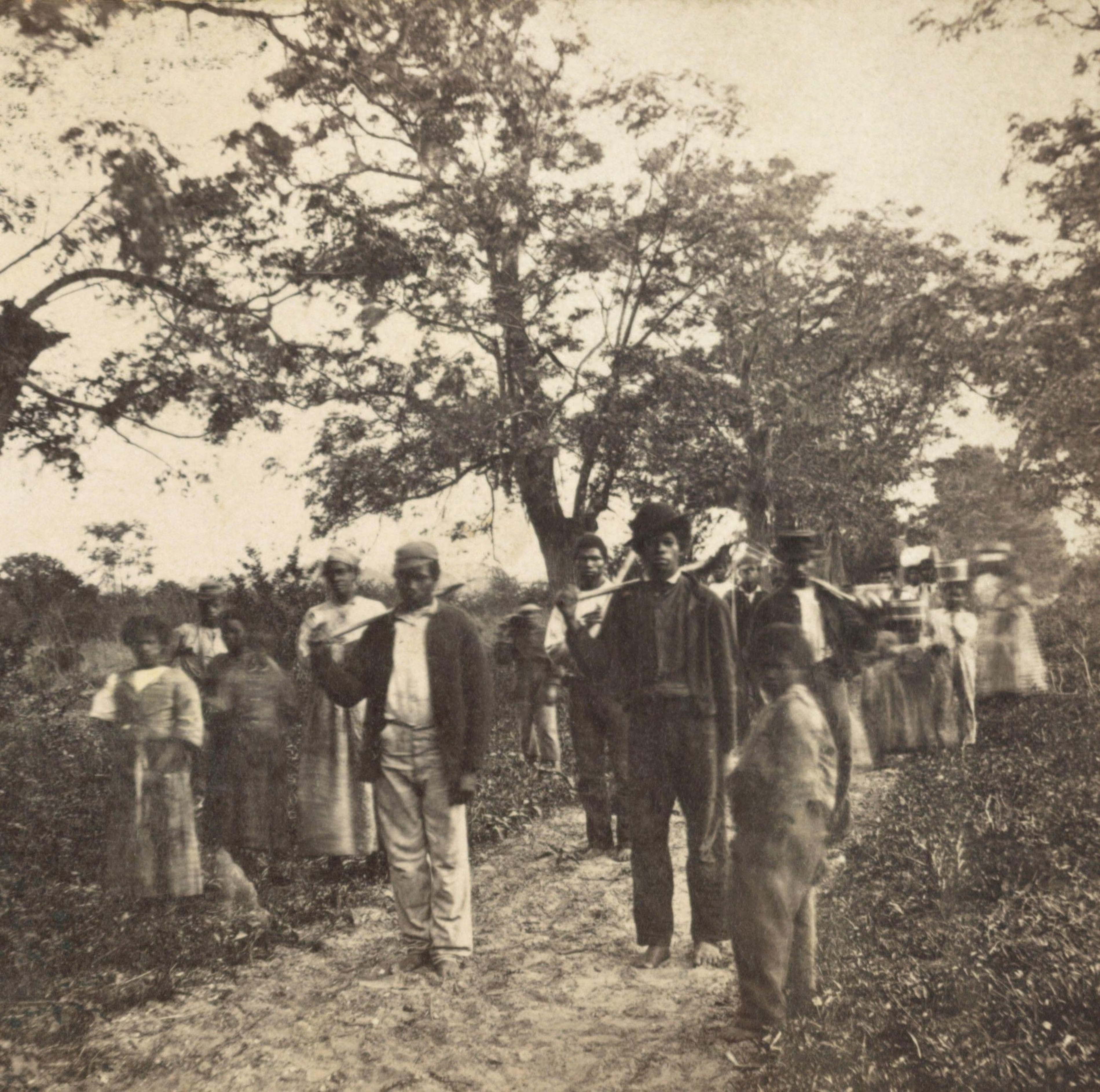
Last May, while driving around St. Helena Island in Beaufort County, South Carolina, I saw a painted sign for the Gullah Festival, which I later learned was an annual gathering to celebrate the history and culture of the Lowcountry’s African descendants, whose origins date back generations. I had never heard of the Gullah or the festival. I felt foolish. As someone who had been visiting the area most of my life, I was woefully ignorant of its history.1
Later that night, after a little digging, I learned that Beaufort is actually located in the Gullah Geechee Cultural Heritage Corridor, which extends south from Wilmington, North Carolina, down to Jacksonville, Florida. It was designated by Congress as a National Heritage Area in October 2006, and is jointly managed by Gullah Geechee Cultural Heritage Corridor Commission and the National Park Service.
As for a primer on the Gullah people, the National Park Service’s website offers a brief but helpful overview:
The Gullah Geechee people are the descendants of West and Central Africans who were enslaved and brought to the lower Atlantic states of North Carolina, South Carolina, Florida, and Georgia to work on the coastal rice, Sea Island cotton, and indigo plantations. Because their enslavement was on isolated coastal plantations, sea and barrier islands, they were able to retain many of their indigenous African traditions. These traditions are reflected in their foodways, arts and crafts, and spiritual traditions. They also created a new language, Gullah, a creole language spoken nowhere else in the world.
What’s not surprising here is that slavery brought the Gullah people to America, resettling them in the south as plantation laborers. But what struck me is how the Gullah as an indigenous community have retained their culture and identity for generations. The machinations of wealth and politics in America normally consumes and homogenizes everything in its path. And with St. Helena Island adjacent to some of the most expensive oceanfront property in the state (i.e., Fripp Island, Hilton Head, etc.), I was surprised it had somehow avoided the bulldozers of real estate developers all these years. Turns out I was wrong.
“The land loss we are dealing with now is due to predatory development and greed,” Luana Graves Sellars told The Guardian in 2023. Graves Sellars is the director at a non-profit called the Lowcountry Gullah Foundation, which helps Gullah families hold on to their land by raising money to pay the outstanding taxes on their behalf.
According to The Guardian, the struggle over Gullah land is not only playing out in Beaufort county. Developers are targeting scenic coastlines in Georgia, North Carolina, South Carolina, and Florida. North of Beaufort County on St. Helena Island, Gullah residents are fighting developers’ plans for golf courses and gated communities. Two hours south of St. Helena Island in Harris Neck, Georgia, Gullah people are engaged in a legal battle over land taken from them by the US government during the Second World War. Nearby on Sapelo Island, Georgia, descendants of people who purchased or were granted the land on which they were originally enslaved are fighting zoning changes that could forever alter the rural pace of an island that has only two paved roads.
II.
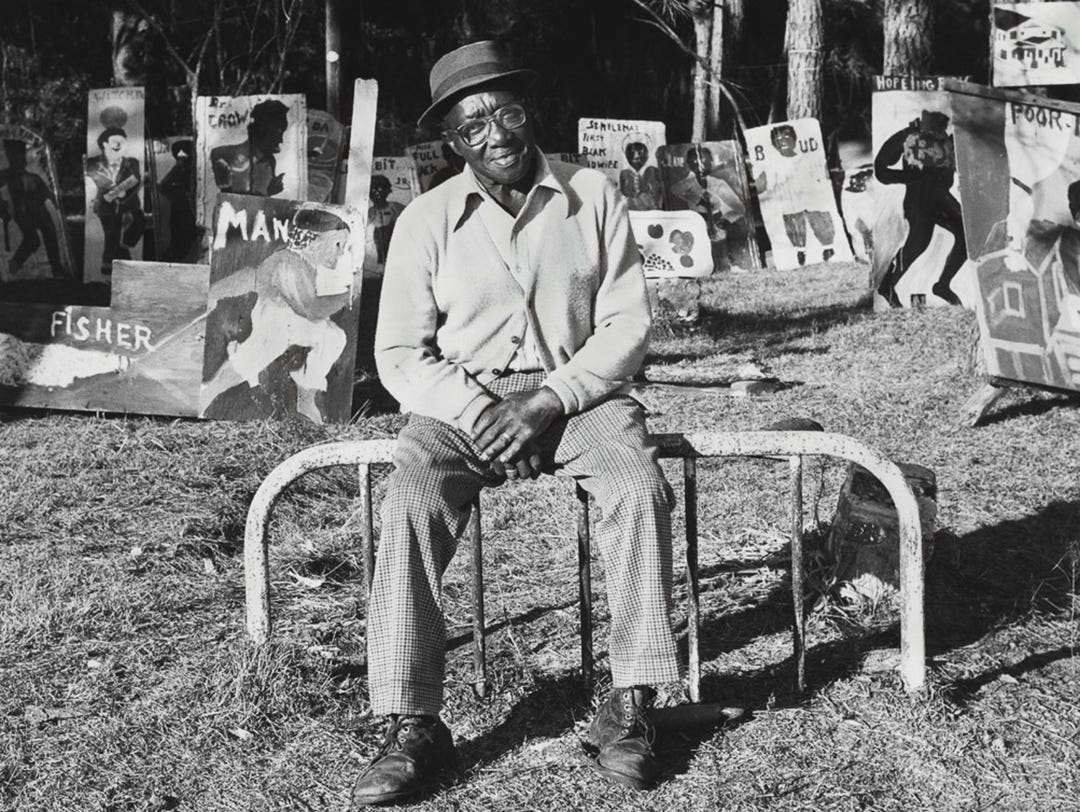
Last month, while listening to The Art Angle podcast, I learned about Sam Doyle (1906–1985), a Gullah artist from St. Helena Island who spent decades painting the people around him—neighbors, preachers, local figures—on salvaged wood and tin. Doyle wasn’t seeking an audience as much as building a record. Like a newspaper of record—think The New York Times or The Plain Dealer—Doyle’s paintings became the art of record for the Gullah people of St. Helena Island. He displayed the paintings in his yard, what he called his outdoor gallery, where anyone passing through could stop and look.
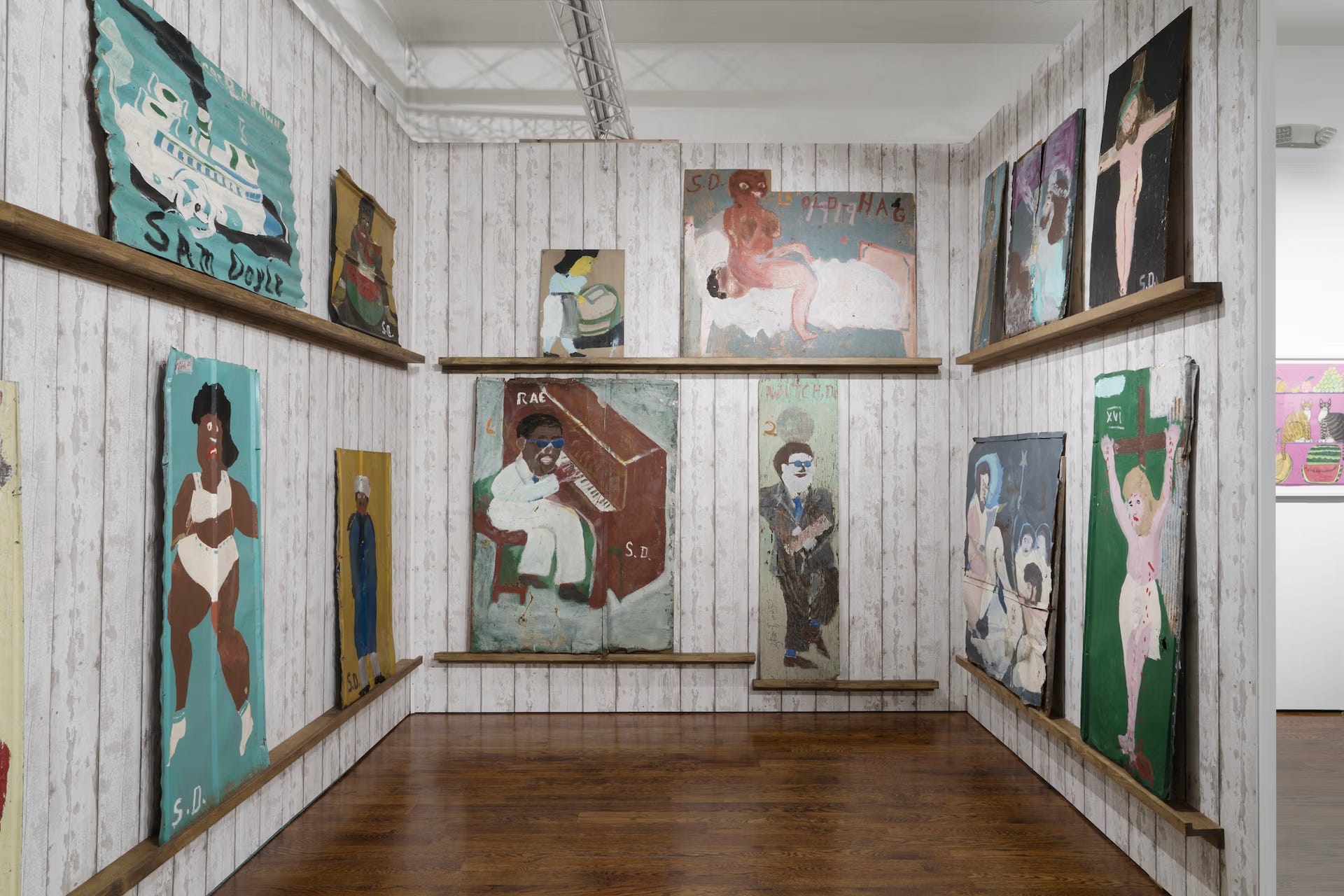
Doyle’s work feels inseparable from the place it came from. He elevated everyday people, painting their portraits with the same seriousness he approached his paintings of Joe Louis, Ray Charles, or Jackie Robinson. He painted in creolized Gullah language, sometimes phonetically, his text folding itself into the image. He wasn’t documenting history at a distance—he was recording it as it unfolded.
For most of his life, that work stayed on the island. It wasn’t until the 1980s, when Jean-Michel Basquiat began collecting Doyle’s paintings, that it started to circulate more widely. And now, decades after Doyle’s death, those same works are being shown at New York’s Outsider Art Fair, the Georgia Museum of Art, and the Gallery of Everything in London—recreated, in some cases, to resemble the yard where they were first displayed.
I keep coming back to that shift in context. Work made from discarded materials—tin roofing, house paint—now hangs in spaces where it’s carefully lit, priced, and explained. What began as a local act of keeping becomes, over time, something else: collected, translated, made legible to people like me who discover new worlds through art, writing, music, or film.
There’s nothing inherently wrong with that kind of discovery. But it raises a question I can’t shake—whether visibility always arrives alongside a kind of distance. Whether a culture has to be removed from its place, or threatened, before the wider world decides it’s worth preserving.
III.
When I think about Sam Doyle now, I keep returning to the idea of his yard—the way he turned it into a space of accumulation and homage, a place of memory held in plain sight. It wasn’t a museum or an exhibition. Instead, transforming his yard was more a refusal to let the people and places he saw disappear. Doyle staged paintings where they were made. They belonged to the same ground as the people they depicted.
I didn’t have that relationship to St. Helena.
For most of my life, it was simply a place I passed through on my way to Fripp Island—a place of privilege that I only had access to because of the generosity of my aunt who invited us each summer when I was a kid. It was familiar but unexamined. I moved through it easily without asking what made that ease possible, or who had done the hard work of actually building Beaufort County and helping grow its wealth.
Learning about the Gullah people—and about Doyle, in particular—complicates that. It makes the landscape feel less like a backdrop and more like a conversation. About memory, about ownership, about what it takes to remain in a place as the conditions around you change.
Doyle painted his community as a way of keeping it intact, or at least of insisting on its presence. But not everything can be preserved that way. Land can’t be painted into permanence. It can, however, be taxed, subdivided, and sold. It can be made untenable to keep.
What I had taken, for years, as continuity now looks more like resistance—fragile, ongoing, and unevenly distributed. The same forces that eventually carried Doyle’s work beyond St. Helena—outside interest, rising value, the slow accumulation of attention—are also reshaping the island itself. Property taxes rise. Developers circle. Indigenous land is divided and lost.
It’s easy to celebrate a culture once it’s been framed, contextualized, and made visible. It’s harder to reckon with the conditions that threaten it in the first place. The question isn’t just how the Gullah story gets told, or where it’s shown. It’s whether the people who made that story can continue to live on the land that made it possible.
📚 Independent, Reader-Supported Publishing 📚
Each issue of Homesick requires extensive time and resources before the writing ever begins. From research, interviews, transcription, and image sourcing to fact-checking, copyediting, proofreading, design, and marketing, the work that goes into each newsletter is substantial. If you enjoy the Dispatches, Essays, and Interviews that I publish each week, please consider supporting my work in one of the following ways:
SUBSCRIBE ➡️ Subscribe to Homesick, free or paid subscription.
RECOMMEND ➡️ Refer Homesick to a friend.
PURCHASE MY BOOK ➡️ Buy Shopping Mall, my book about the curiosity, ritual, and fantasy of the American mall.
TIP YOUR EDITOR ➡️ Not ready for a paid subscription? Tip your editor via PayPal.

I was in South Carolina to make good on a promise to my mother, that I would return her ashes to Beaufort—and more specifically, Fripp Island—one of her favorite places in the world. Telling the story of that experience has grown into a long-form essay that I hope to publish here at some point this summer.
not to be annoying but i want a whole book of these essays.